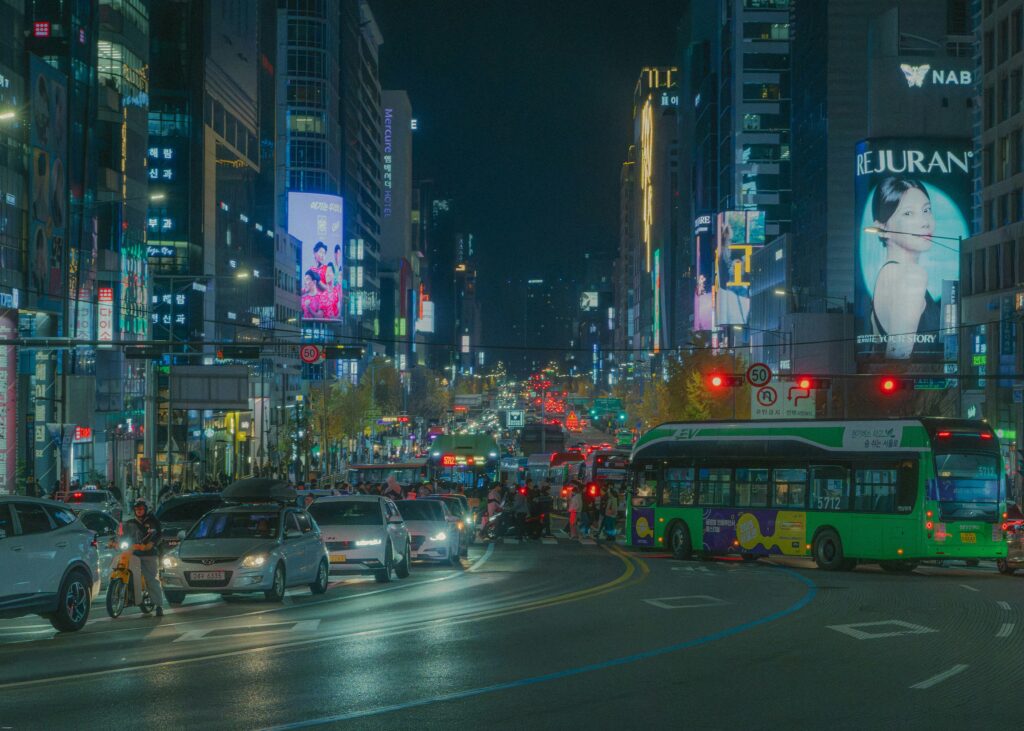
Photo by Jinhan Moon on Unsplash
Getting around South Korea by public transportation is incredibly efficient, but a few local rules can be tricky for first-time visitors. From transfer gates to payment methods, here is a clear, fact-based guide to help you navigate like a pro.
💳 1. The Payment Essential: Physical Cards Only
Before you head to the turnstile, there is one critical thing to know: International Apple Pay, Google Pay, or Samsung Pay (foreign-issued) are not currently supported at Korean subway gates or on buses.
- Get a T-money Card: You must use a physical transit card like T-money, Wowpass, or Namane.
- Cash for Top-ups: These cards are easy to find at convenience stores, but recharging them usually requires physical Korean Won (cash) at the station machines.
📍 2. The “15-Minute Rule” for Mistaken Exits
Did you accidentally tap out at the wrong station? Or realized you went to the platform for the opposite direction?
- The Grace Period: Within the Seoul Metro system (Lines 1–9), you can re-enter the same station within 15 minutes without being charged a new base fare.
- How it works: Your re-entry will be treated as a “transfer,” so you won’t lose extra money for a simple mistake.
- Note: This rule generally applies to Seoul-operated lines. Some private suburban lines might still charge a new fare.
🚉 3. Special Lines: Not All Subways are Equal
You might see different colors or encounter extra gates inside a station. Here is what they mean:
- Line 9 & Shinbundang Line (Transfer Gates): You will often see “transfer gates” inside the station when switching to these lines. Don’t worry—it’s not a double charge. It’s just tracking your movement between different operators.
- Shinbundang Line (The Premium Line): This line connects Gangnam to southern suburbs faster. Because it is privately managed, a surcharge (approx. 700–1,000 KRW) is added when you pass through its gates.
- AREX (Airport Railroad): * All-stop Train: Works with T-money and allows standard transfers.
- Express Train (Orange): Requires a separate reserved seat ticket and does not integrate with the standard bus/subway transfer discount.
- Gyeongui-Jungang & Suin-Bundang Lines: These lines often have longer gaps between trains (sometimes 15–20 minutes). It is highly recommended to check Naver Map or KakaoMap for real-time schedules.
🚌 4. Bus + Subway Transfers: The 30-Minute Window
One of the best parts of Korea’s system is the integrated fare between different modes of transport.
- The Time Limit: Transfers are free (or heavily discounted) if you board your next vehicle within 30 minutes after tapping off (extended to 60 minutes at night, 9 PM – 7 AM).
- Tap Off Every Time: You must tap your card on the reader when getting off a bus. If you forget, the system cannot validate your transfer, and you will be charged a penalty fare on your next ride.
📌 Key Takeaways for a Smooth Journey
- Carry a Physical Card: You cannot rely on your phone for transit yet.
- Follow the “Transfer” Signs: Don’t follow the “Way Out” sign unless you are actually leaving the station.
- 15-Minute Re-entry: If you make a mistake at the gate, go back in within 15 minutes to save your fare.
- Expect Surcharges on Express Lines: Lines like the Shinbundang Line cost more, but they save a lot of time.
- One Card per Person: For subway transfers, every traveler needs their own physical card.
Blog Note: This information is based on current transit policies in Seoul. While the system is very reliable, specific rules can vary slightly in other cities like Busan or Jeju. I hope this helps you explore Korea with confidence! 🙂